Uganda’s largest national park does not get the name recognition of the Maasai Mara or the Serengeti, and that keeps it quieter than parks a fraction of its size. Murchison Falls National Park covers roughly 3,893 km2 along the Victoria Nile, anchored by a waterfall that squeezes one of Africa’s biggest rivers through a gap barely wider than a doorway. Lion, leopard, buffalo, and elephant all live here in solid numbers, alongside one of Uganda’s largest populations of Rothschild’s giraffe. Touring Insights breaks down the real distances, fees, and named camps behind a Murchison Falls trip, and what “Big-Four-Plus” actually means on the ground.
Murchison Falls National Park by the Numbers
| Figure | Detail |
|---|---|
| Park size | approx. 3,893 km2, Uganda’s largest national park |
| River | Victoria Nile, bisects the park east to west |
| Falls drop | approx. 43 m through a gap roughly 7 m wide |
| Main entry gates | Kichumbanyobo Gate (south), Tangi Gate (north, near Chobe) |
| Nearest airstrips | Pakuba, Bugungu, Chobe (Aerolink flights from Entebbe) |
| Bird species recorded | approx. 450, including the shoebill stork in the delta |
| Rothschild’s giraffe population | approx. 1,500, one of Uganda’s largest concentrations |
Figures come from Uganda Wildlife Authority reporting and shift slightly year to year. Confirm current counts with UWA before citing them elsewhere.
The Falls Themselves: How Uganda’s Most Powerful Waterfall Works
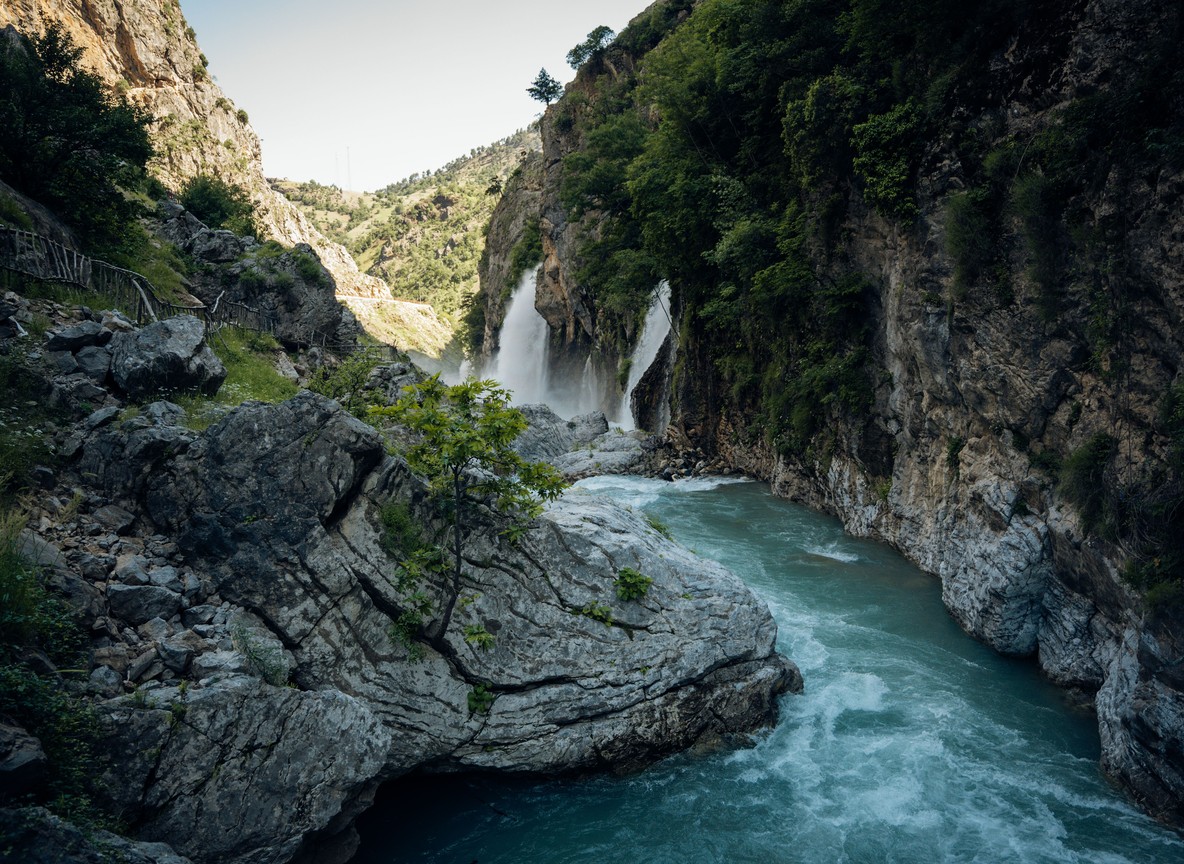
The Victoria Nile carries the outflow of Lake Victoria north toward Lake Albert, and at Murchison it hits a wall of rock with only one way through. It narrows from roughly 50 m wide to about 7 m, then drops some 43 m in a single churning burst. Guides at the park often describe it as the most powerful waterfall on earth for its width, since so much water forces through such a tight gap. Two viewpoints frame the experience differently. Top of the Falls, reached by a short walk from a parking area on the south bank, puts visitors within a few meters of the drop, close enough to feel the spray and hear the roar over conversation. The base of the falls is a boat trip away, part of the Nile cruise most visitors build a full morning or afternoon around.
Downstream from the falls, the Nile widens out again and slows into the papyrus-lined delta where it meets Lake Albert. That stretch of water is calmer and shallower, which is exactly why the shoebill stork favors it. Boat cruises heading toward the delta run separately from the base-of-falls trip, and lodges often package the two as a longer half-day option rather than two short outings.
Big-Four-Plus: The Wildlife You’ll Actually See
Murchison does not have rhino, so it never carries a true Big Five. What it does carry is a dependable Big Four, lion, leopard, buffalo, and elephant, plus a wildlife story few other Uganda parks can match. The “plus” is Rothschild’s giraffe, an endangered subspecies reintroduced here after near-disappearance elsewhere in East Africa, now numbering around 1,500 animals in the park. Game drives on the Buligi Peninsula, the wedge of savanna between the Victoria Nile and the delta, produce the most reliable big-game sightings, with Uganda kob herds drawing lion prides into the open. Leopard sightings run more opportunistic, usually along riverine tree lines at dawn or dusk. For travelers who want rhino on the same trip, Ziwa Rhino Sanctuary sits directly on the Kampala-to-Murchison road and works as an add-on stop rather than a park detour.
Murchison Falls vs Queen Elizabeth National Park
Uganda’s two flagship savanna parks get compared often, since both sit on popular northern-circuit itineraries.
| Factor | Murchison Falls NP | Queen Elizabeth NP |
|---|---|---|
| Park size | approx. 3,893 km2 | approx. 1,978 km2 |
| Signature feature | Victoria Nile waterfall and boat cruise | Kazinga Channel and tree-climbing lions |
| Distance from Kampala | approx. 305 km, 5 to 6 hr drive | approx. 420 km, 6 to 8 hr drive |
| Nearest airstrip | Pakuba, approx. 45 min flight from Entebbe | Kasese or Mweya, approx. 1 hr flight from Entebbe |
| Rhino present | No, nearest at Ziwa Rhino Sanctuary en route | No |
| Chimp trekking option | Budongo Forest Reserve, on site | Kyambura Gorge, on site |
| Typical stay | 2 to 3 nights | 2 to 3 nights |
Both parks pair well on a single Uganda itinerary, usually linked by the drive through Kibale Forest for a chimp-trekking stop between them.
Getting to Murchison Falls: Routes, Airstrips, Drive Times
Most travelers reach Murchison Falls by road from Kampala, a drive of roughly 305 km that takes 5 to 6 hours through Masindi. The route enters the park through Kichumbanyobo Gate on the south side, close to Sambiya River Lodge and the road down to Paraa. A second entry point, Tangi Gate, serves the northern circuit near Chobe. Travelers pressed for time can fly instead. Aerolink and other charter operators run scheduled flights from Entebbe into Pakuba, Bugungu, or Chobe airstrips, cutting the trip to under an hour. From any of the three airstrips, it is a short transfer to the lodges clustered around Paraa on both banks of the Nile.
A ferry crossing links the north and south banks near Paraa, running on a set schedule through the day. Travelers staying on one bank and driving on the other should build the ferry wait into the plan, since queues form fast during peak morning game-drive hours. Self-drivers coming from Kampala should also budget extra time for the Masindi stretch, where the tarmac gives way to graded murram road for the final approach to Kichumbanyobo Gate.
Where to Stay Near Murchison Falls
Lodging spreads across both riverbanks and both price tiers. Paraa Safari Lodge sits directly above the Nile on the north bank, the most established option with river-view rooms and its own jetty for boat cruises. Chobe Safari Lodge, near Tangi Gate on the eastern boundary, overlooks a set of Nile rapids and works well for travelers arriving from Kidepo or northern Uganda. Nile Safari Lodge and Baker’s Lodge offer smaller, more intimate tented options on the south bank, closer to Top of the Falls. Budget travelers use Red Chilli Rest Camp, a long-standing backpacker base near Paraa with camping and simple bandas. Most lodges arrange boat cruise bookings and game drive vehicles directly, which simplifies planning around early wake-up calls.
Budongo Forest: Chimp Trekking Without Leaving the Park System
Budongo Forest Reserve sits just south of the main park, reached on the same road in from Masindi, and adds a primate trek to a Murchison itinerary without a separate destination. Kaniyo Pabidi, the main trekking site, holds a habituated chimp community along with black-and-white colobus and blue monkeys. Permits run at an indicative USD 100 per person, well below Uganda’s gorilla permits, and treks typically take two to four hours depending on how far the group has ranged overnight. A shorter forest walk option at Busingiro covers similar terrain at a slower pace, better suited to birders. Pairing a Budongo chimp trek with a Murchison game drive and boat cruise fills a comfortable two-night stay without backtracking.
Explorer Notes
Book the Nile boat cruise for the morning departure if the schedule allows. Later cruises run in stronger heat, and the shoebill stork sightings in the delta section are more reliable before midday winds pick up. The Top of the Falls walk is short but exposed, so bring water and a hat even for a 20-minute stop. Buligi Peninsula game drives work best right after the gate opens, before vehicle traffic bunches up around the main kob herds. If chimp trekking at Kaniyo Pabidi, wear long sleeves regardless of heat. Forest ants and thorny undergrowth cause more discomfort on this trek than the actual walking distance. Rangers at Paraa can advise same-day on which side of the river is producing better lion sightings, since prides shift between the delta and the Buligi plains through the season.
FAQ
How big is Murchison Falls National Park? Murchison Falls National Park covers approximately 3,893 km2, making it Uganda’s largest national park.
Does Murchison Falls National Park have the Big Five? No. Murchison has a reliable Big Four of lion, leopard, buffalo, and elephant, but no rhino population inside the park. Ziwa Rhino Sanctuary, on the road in from Kampala, is the nearest place to see rhino.
How far is Murchison Falls from Kampala? By road, it is roughly 305 km and a 5 to 6 hour drive through Masindi. By air, charter flights from Entebbe into Pakuba, Bugungu, or Chobe airstrips take under an hour.
How much does the Murchison Falls boat cruise cost? Indicative pricing for the Nile cruise to the base of the falls runs in the tens of dollars per person, on top of standard park entry fees. Confirm current rates with Uganda Wildlife Authority or your lodge before booking.
Can I do chimp trekking at Murchison Falls? Yes, at Budongo Forest Reserve just south of the main park. Kaniyo Pabidi offers a habituated chimp community with indicative permit pricing around USD 100 per person.
What to Read Next
- Comparing Uganda’s two flagship savanna parks? See the Murchison Falls vs Queen Elizabeth breakdown above.
- Building a wider Uganda primate circuit? Kibale Forest often links Murchison Falls with Queen Elizabeth on a single itinerary.
- Planning rhino tracking alongside the Big Four? Ziwa Rhino Sanctuary sits directly on the Kampala road in.
Murchison Falls rewards a slower, two-to-three-night stay over a rushed day trip. Check the Tour Packages page for itineraries that route through Murchison, or ask a partner operator to confirm current boat cruise and chimp permit availability before you lock in dates.
Further reading
More safari planning resources
- Kenya national parks map from SafariPure
- Nairobi to Maasai Mara route guide from Valley Safaris
- Big Five safari parks guide on Touring Insights
- Big Five safari collection on FindMySafari
Related guides: Amboseli Dawn vs Afternoon Game Drives: How the Park Changes Through the Day.